

)


)


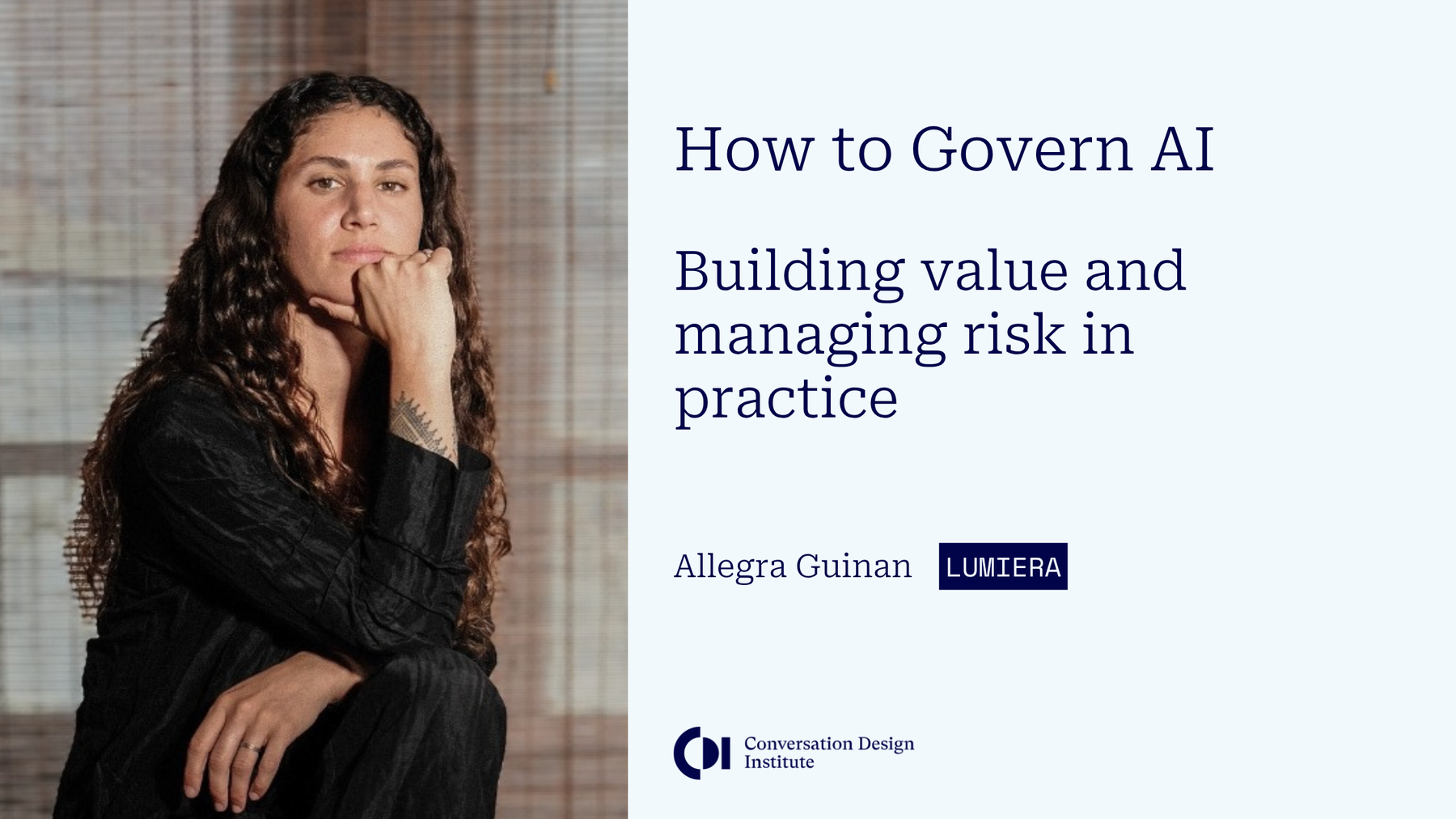
What responsible AI governance looks like across the full lifecycle
On March 19, 2026, Allegra Guinan joined the Conversation Design Institute for a practical session on AI governance. The webinar explored how organizations can manage risk and measure value across the entire lifecycle of an AI initiative, from early experimentation to production and monitoring.
The discussion focused on what governance actually looks like in operational practice and how teams can build guardrails that support innovation rather than slow it down.
Why AI Governance Matters
As AI becomes embedded in products and services, organizations face increasing pressure to manage risk responsibly.
Governance provides the structure needed to ensure AI systems remain transparent, accountable, and aligned with organizational goals. When implemented well, governance frameworks help teams maintain trust while enabling sustainable innovation.
Moving Beyond Policy Documents
Many organizations begin their governance journey by creating policy documents and ethical guidelines.
While these are important starting points, they rarely provide practical guidance for teams working with real AI systems. Governance becomes meaningful when it is integrated into everyday development workflows.
The session explored how governance frameworks can guide decision making throughout the AI lifecycle rather than existing as static documentation.
Measuring Risk Across Stages
Risk in AI systems changes as projects evolve. Early exploration requires different safeguards than production systems operating at scale.
The webinar examined how organizations can measure risk across different stages of development. From early experimentation to deployment and monitoring, teams need evaluation processes that help identify potential failures before they affect users.
Connecting Governance and Value
Governance is often framed purely as a risk management exercise. In practice, strong governance also supports better measurement of value.
By establishing clear metrics and evaluation processes, organizations can better understand how AI systems contribute to business outcomes and user experiences.
Governance helps teams answer an essential question: not only whether a system is safe, but whether it is delivering meaningful results.
Building Guardrails for Innovation
One of the most common concerns around governance is that it may slow innovation.
The goal of governance is not to restrict experimentation but to create guardrails that allow teams to innovate responsibly. Clear processes help teams move faster by reducing uncertainty and preventing costly mistakes later in the lifecycle.
Meet the Speakers

Allegra Guinan
Co-founder and CTO, Lumiera
Allegra Guinan is co founder and CTO of Lumiera, a boutique advisory firm that helps organizations design responsible AI strategies. She combines strategic leadership with deep expertise in system architecture, data engineering, and machine learning operations.
At Lumiera, Allegra works with organizations to build resilient AI capabilities and guide leaders through the complexities of implementing responsible AI systems at scale..
Meet the Speaker
This blog highlights key ideas from the session, but the full discussion offers deeper insight into how governance works in real AI initiatives.
Watch the full webinar here:
