

)


)

Conversational AI support offers continuous availability, handling routine inquiries and basic tasks like appointment scheduling, ensuring patients always have access to essential information.
Use Case
Conversational AI for Healthcare
Healthcare 2.0
In regulated markets, automation is complex, but Conversational AI for Healthcare improves efficiency while enhancing patient and employee satisfaction.
AI-powered assistants reduce admin time by handling appointments and queries, allowing healthcare staff to focus on critical care, where humans excel.
Industries
Functions

Healthcare and patient care
In healthcare, getting AI conversations right means getting them right for patients: accurate, private, and easy to use at a stressful moment. Done right, AI assistants carry the routine load so staff can focus on care. Here's where they deliver.

The business case for conversational AI
In healthcare, getting AI conversations right means getting them right for patients: accurate, private, and easy to use at a stressful moment. Done right, AI assistants carry the routine load so staff can focus on care. Here's where they deliver.
Available 24/7
Better handle peak times
During high-volume periods, the reduced response times help decrease the burden on medical support staff.
Cost savings
Well-implemented AI healthcare support solutions can reduce administrative costs through increased automation and improved working conditions for support staff, ultimately enhancing efficiency while maintaining high standards of patient care.
Educating patients
Chatbots and voice assistants can deliver quick and accurate information on treatments, conditions, and preventive care.
Appointment management
AI assistants can assist patients with booking, rescheduling, and canceling appointments when integrated with your booking systems.
Symptom checkers
Virtual assistants can provide preliminary symptom assessments and recommend next steps, like consulting a specialist.
Insurance and billing support
AI assistants can guide patients through insurance claims, billing inquiries, and payment processes to make sure they aren’t left with any questions or money worries.
Follow-up care coordination
Automate post-visit follow-up, sending personalized check-ins and coordinating with care teams to ensure patients stay on track with their treatment plans.
Conversational AI, at scale
Understand how your organisation can put Conversational AI to work with the help of CDI. Work with our experts, or give your team the tools and training to build successful AI assistants.

Trusted by global brands
“It was a pleasure working with the CDI team. Each team member was extremely professional and brought deep expertise in their area of focus – AI training, copywriting, and conversation design.”
)
“It’s been great working with CDI. They helped us get started quickly with the setup of our first chatbot and the first results are promising. Their consultants are knowledgeable, creative, and think along in order to build and maintain a good performing chatbot.”
)

“Having the expert advice from CDI has really helped us to create with confidence the first version of the global Experience Strategy Framework and distribute it to the design community across all Vodafone markets.”
)

“CDI is the leading expert in the conversational landscape and we’re really happy they shared their knowledge during the workshops with us. Moreover, we applaud them for making our students enthusiastic about this field of work!”
)


About the CDI Standards Framework
When organisations want to have more interactions on their conversational channels than their contact centres have the capacity for, they reach for conversational AI solutions to automate a large part of the interactions.
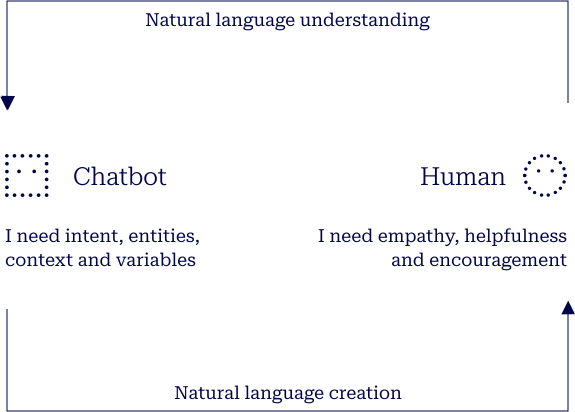
But this is not easy to do. People and machines have different ways of interacting so building a good AI Assistant requires a unique understanding of technology, linguistics, and psychology.
CDI has worked with leading organisations around the world and has systematised the proven ways of creating successful AI assistants, and the enterprise capabilities that develop, manage, and grow them: the CDI Standards Framework.
CDI Standards Framework
Unlocking value in Conversational AI
The CDI Standards Framework is a collection of proven strategies helping organisations deploy AI assistants at scale. Our knowledge is grounded in years of experience training successful Conversational AI teams.



CDI Standards Framework is our definition of what it takes to get AI conversations right: thirty-one standards across six domains, each with maturity levels, grounded in years of experience with the world's leading conversational AI teams.

CDI Workflow
is a systematic approach to developing a conversational AI capability: thirty-one standards across six domains, each evaluated through Four Forces, Mindset, Skillset, Culture and Systems, developed together, at the right pace.
The workflow works for all conversational channels, is technology agnostic, and works for both declarative and generative AI approaches.
Discover our case studies
Assessing, improving and implementing the building process for a cosmetics chatbot

Conversation Design Institute (CDI) was asked to perform a fast track audit. This improved the inter…
Honeybook explores Agentic Experience Design

CDI enjoyed hosting a group of talented content and design experts from Honeybook for a one day work…
Boosting Voice AI Performance for Deutsche Telekom

CDI equipped Deutsche Telekom's mixed team of engineers, business stakeholders, and designers with t…
Leading Global HR Services Provider

Conversation Design Institute (CDI) was asked to help redesign the chatbot of a global leader in wor…
IND embraces Conversational AI as a channel

The IND is the Immigration and Naturalisation Service (Immigratie- en Naturalisatiedienst). Their 'c…
Global Sports Retail Chatbot

A Forbes 500 sports retail brand launched their customer service chatbot in the US market in 2020. I…
Migrating Hansgrohe's Chatbot, Hans

The Hansgrohe Group, a leading German sanitation company, is known for its premium brands Hansgrohe…
Migrating Trulet’s Chatbot, Trudi

Trulet, an Australia-based company, created Trudi—an innovative AI chatbot for real estate that enha…
Expanding multilingual IVR support

A leading global provider of cutting-edge software and services, embarked on a transformative journe…
Goodcall’s AI Phone Assistants

Goodcall is a California-based startup that specializes in delivering AI-powered phone assistants th…
Healthcare HR Chatbot

Over the course of two years, CDI worked with one of the world’s leading pharmaceutical companies to…
Vandebron’s Chatbot, Mick

Conversation Design Institute worked with Dutch energy company Vandebron to build and launch their c…
Vodafone’s Virtual Assistant, TOBi

Vodafone Group Plc, Europe’s largest Mobile and Fixed Network Operator, serves over 300 million mobi…
HP’s Virtual Assistant

HP Inc. is a technology company that believes one thoughtful idea has the power to change the world.…
Conversational Capital
Every conversation your AI has is a deposit or a withdrawal from the trust your customers hold in you. Conversational Capital is how you measure that trust, and grow it. Want to know what it means for your AI? Get in touch and we'll walk you through it.
Get in touch
Form submitted
Thanks, we’ll be in touch soon.
The idea
Customers don't experience your AI as technology; they experience it as your brand talking. Every helpful conversation builds trust, and every failure spends it. That accumulating trust is Conversational Capital.
Measure it
A Conversational Capital Assessment reads your real conversations and returns your Conversational Capital Rating: a score of whether your AI is building trust or burning it, and where.
Grow it
Trust compounds when conversations are right. The framework shows which conversations to fix first, so every quarter your AI earns more trust than it spends.
Get in touch
Form submitted
Thanks, we’ll be in touch soon.
FAQs
What is conversational AI in healthcare?
Conversational AI in healthcare refers to technologies like chatbots and virtual assistants that help healthcare providers improve communication, automate administrative tasks, and collect valuable patient data. It increases accessibility to care and provides a more personalized patient experience.
Which AI tool is best for healthcare?
The best AI tool for healthcare varies depending on specific needs. Tools for patient communication, data analysis, or diagnostic support are all valuable. Chatbots, such as digital assistants, improve patient interactions, while machine learning models help analyze medical data. Choose a tool that best suits your healthcare goals.


