

)


)


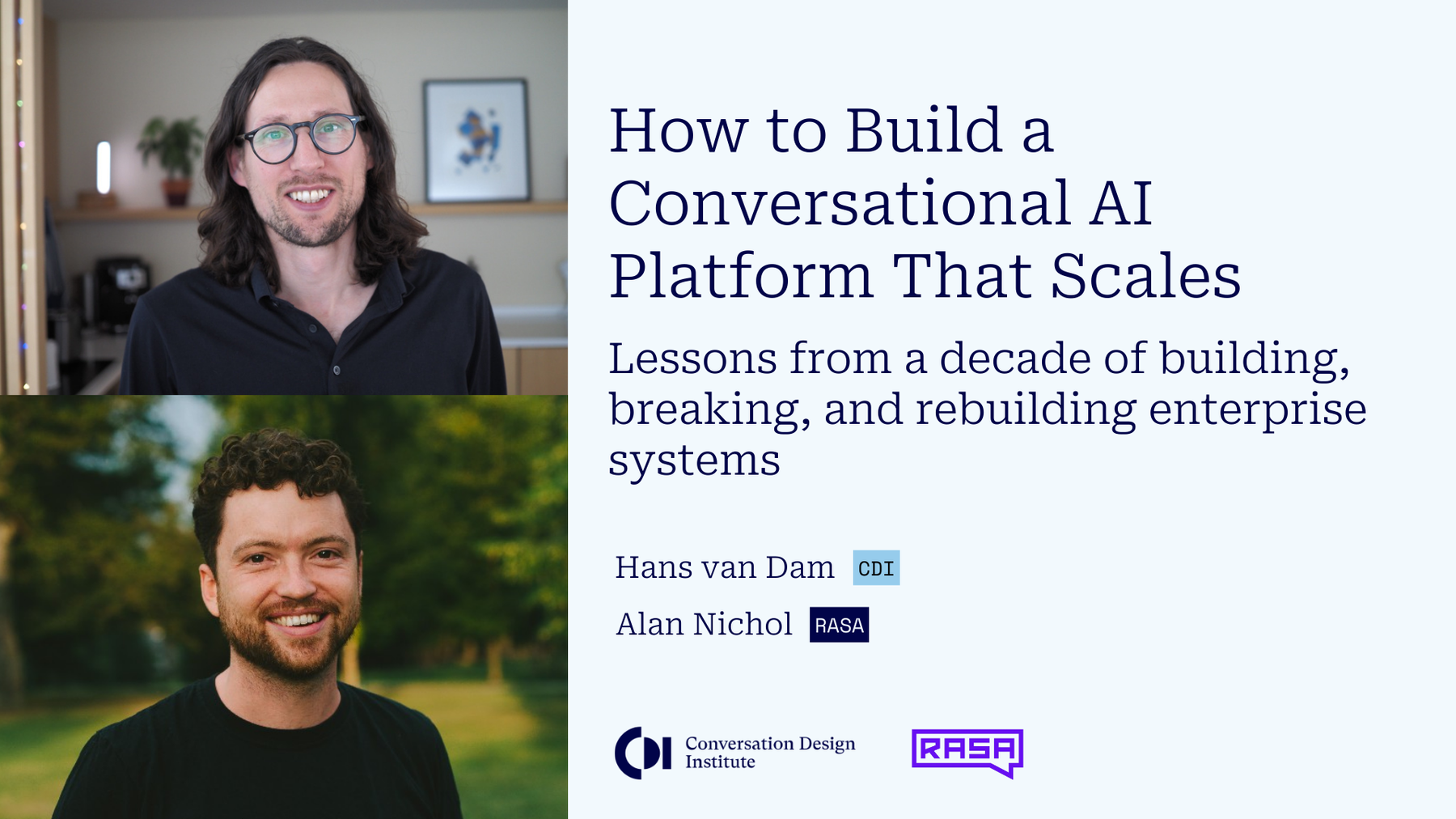
What it takes to move conversational AI from prototype to production
In February 2026, Alan Nichol and Hans van Dam hosted a candid discussion on what it really takes to build conversational AI platforms that hold up in enterprise environments. The session explored how the field has evolved in the LLM era, what challenges organizations encounter as systems scale, and what successful teams do differently.
This webinar focused on the realities of production deployments rather than product demos or industry hype.
Why Scaling Conversational AI Is Still Hard
Over the past few years, conversational AI has evolved quickly. Large language models have expanded what systems can do, and many organizations are exploring autonomous agents and more dynamic conversational experiences.
Despite these advances, scaling conversational AI remains difficult. Many teams move quickly from prototype to deployment without the architectural foundations required for long-term stability.
This session explored the gap between experimentation and sustainable platform design, highlighting why conversational AI must be treated as infrastructure rather than a short-term feature.
Moving Beyond Intent-Centric Architectures
For years, intent classification formed the foundation of most conversational systems. As language models became more capable, the industry began discussing the move “beyond intents.”
During the webinar, Alan Nichol explained what that shift actually means in practice. While modern systems rely less on rigid intent hierarchies, they still require structured architecture, evaluation strategies, and clear boundaries around system behavior.
The discussion emphasized that moving beyond intents does not eliminate the need for design discipline. Instead, it changes how that discipline is implemented.
Lessons from Enterprise Deployments
Alan shared insights from years of working with enterprise teams building conversational systems in production environments.
These deployments often reveal challenges that do not appear during early prototypes. Issues related to governance, evaluation, knowledge management, and system ownership tend to surface once systems scale across channels and departments.
Successful teams treat conversational AI as a long-term capability rather than a one-time project. They invest in processes that support monitoring, improvement, and ongoing system maintenance.
What Breaks First as Systems Grow
As conversational systems become more autonomous, new risks appear.
Evaluation frameworks become essential for maintaining trust in system responses. Knowledge sources must be structured carefully to avoid inconsistency. Platform decisions made early in a project often determine whether a system can evolve successfully.
The webinar highlighted how many organizations underestimate these challenges and only address them after systems begin to fail.
Architecture Decisions That Shape Long-Term Success
One of the central themes of the session was the importance of platform architecture.
Conversational AI systems must integrate multiple layers, including language models, knowledge systems, conversational logic, and governance frameworks. When these components are designed carefully, teams can scale capabilities while maintaining reliability.
When architecture is treated as an afterthought, systems become difficult to manage and improve over time.
What Successful Teams Quietly Get Right
The discussion concluded with observations about organizations that successfully deploy conversational AI at scale.
These teams tend to focus on clear ownership, structured evaluation practices, and collaboration between design, engineering, and product teams. They prioritize long-term system health rather than short-term demonstrations of capability.
In many cases, the most important success factors are not technical breakthroughs but disciplined operational practices.
Meet the Speakers
Alan Nichol
Co-founder and CTO, Rasa
Alan Nichol is the co-founder and CTO of RASA, one of the leading platforms for enterprise-grade conversational AI. He has spent more than a decade working at the intersection of machine learning, product development, and real-world conversational systems.
Alan has long advocated for more resilient approaches to conversational AI, challenging rigid intent-centric chatbot design well before the rise of large language models. At Rasa, he works closely with global enterprises to help teams move conversational systems from prototypes into reliable production platforms.
Hans van Dam
CEO and Co-founder, Conversation Design Institute
Hans van Dam co-founded the Conversation Design Institute to professionalize the role of conversation design within large enterprises. Since 2018, CDI has developed industry standards, certification programs, and consulting services that help organizations build and scale conversational AI capabilities.
Hans focuses on bridging conversational design, platform strategy, and organizational governance to ensure conversational systems remain usable, reliable, and sustainable as they grow.
Watch the Full Webinar
The complete recording of the session is available below.
If you are responsible for conversational AI strategy, platform architecture, or enterprise deployment, this discussion offers valuable insight into what it takes to build conversational AI systems that continue to perform as they scale.
