


Most AI assistants go unmeasured because evaluation sounds like a data project. It needn't be.

Conversational Capital
Repeat calls, lost customers and lost trust.
The Conversational Capital Rating (CCR) finds all three in your conversations months before they reach your accounts, and shows you what to fix first.

And so is the call volume on the same topics. The AI claims success in its logs while customers find another door. This is false containment, and it's where most of the invisible value destruction lives.

Complaints are not. The customers who give up halfway through don't complete surveys. The metric is filtered toward the people who already got what they wanted.

Trust is going with it. Speed measures how cheaply the call was handled. Not what the conversation left behind in the customer's head.
“Stop thinking of conversations as costs to be managed. Start thinking of them as moments where an asset is built or destroyed.”

One rating for your assistant, what broken trust is costing you, and what to fix first.
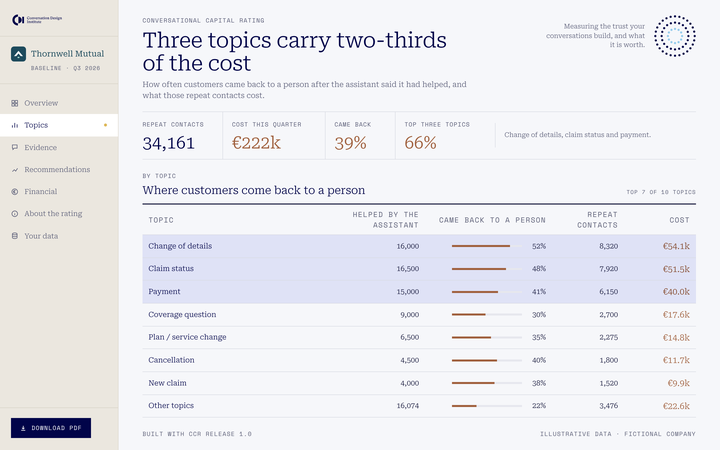
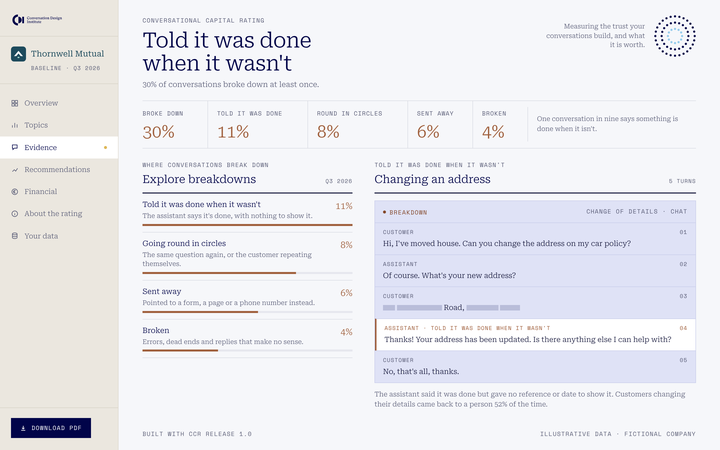
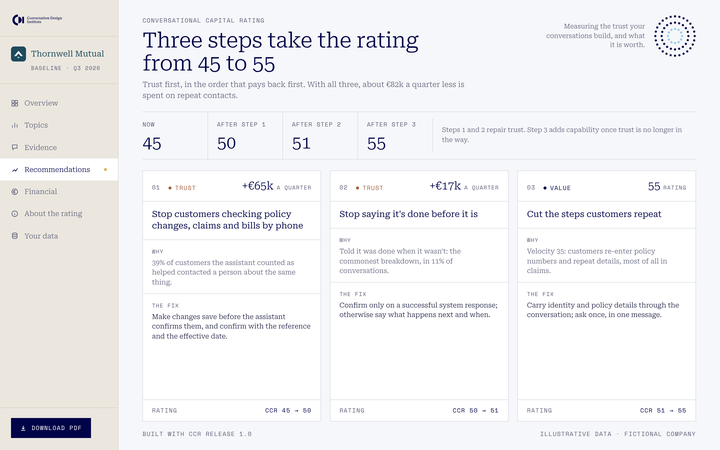
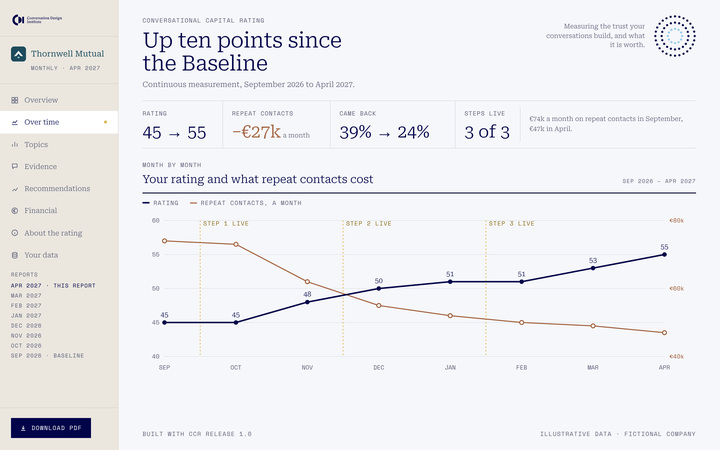
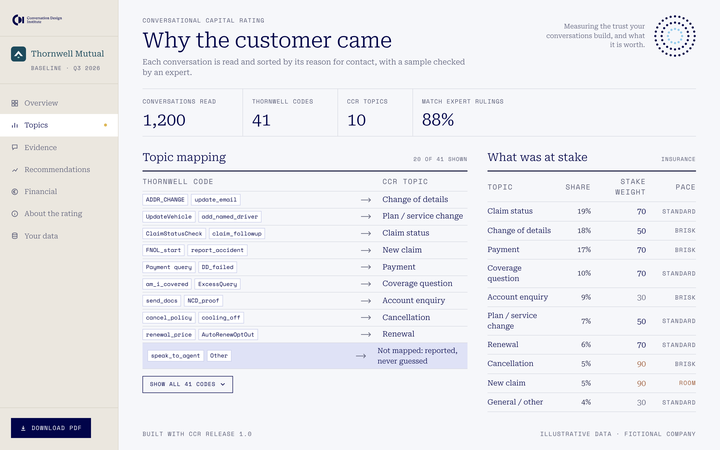
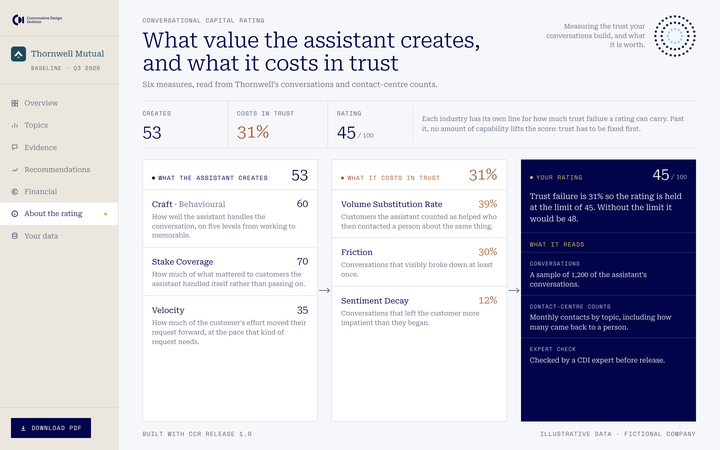
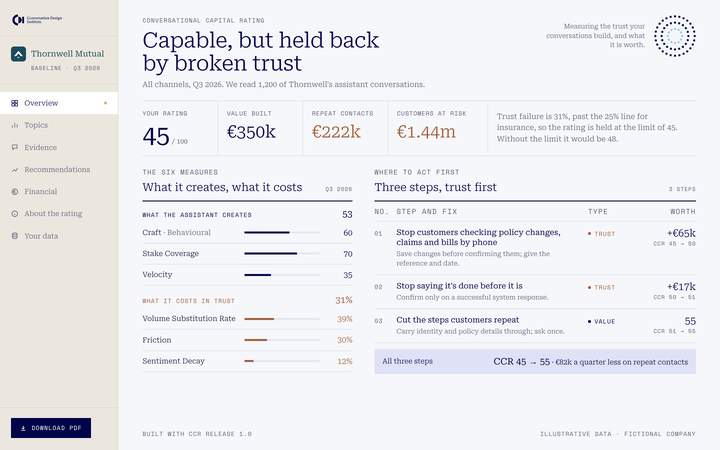
How the Conversational Capital Rating measures what an AI assistant is building with customers and what it is spending.
Most AI assistants go unmeasured because evaluation sounds like a data project. It needn't be.
The most expensive assistant is a capable one that customers have stopped using.
A balance check and a stalled claim both deserve a good conversation. Good means different things.
A conversation can get every step right and still leave the customer angrier than they came.
A conversation can close properly and still have failed. Containment never sees it.
Your dashboard records a success. Two days later the customer rings to check.
One clock for every conversation rewards the assistant that hurries a grieving customer.
Eight in ten handled can still mean the conversations that mattered went to the phones.
A conversation that ended is not one that went well. Most dashboards can't tell the difference.
Containment says your assistant is paying its way. The customers who called anyway may disagree.
Conversational Capital is the accumulated trust and goodwill built through every customer interaction; think of it as a trust bank, where each conversation is a deposit or a withdrawal.
Emotional Debt is Conversational Capital in reverse: too many withdrawals from the trust bank, built up across millions of interactions. Learn how the debt builds, how to spot it, and why you fix the root cause before it shows up in public.

What Conversational Capital is, how you build it through Empathy and Agency, and how you protect it through governance.
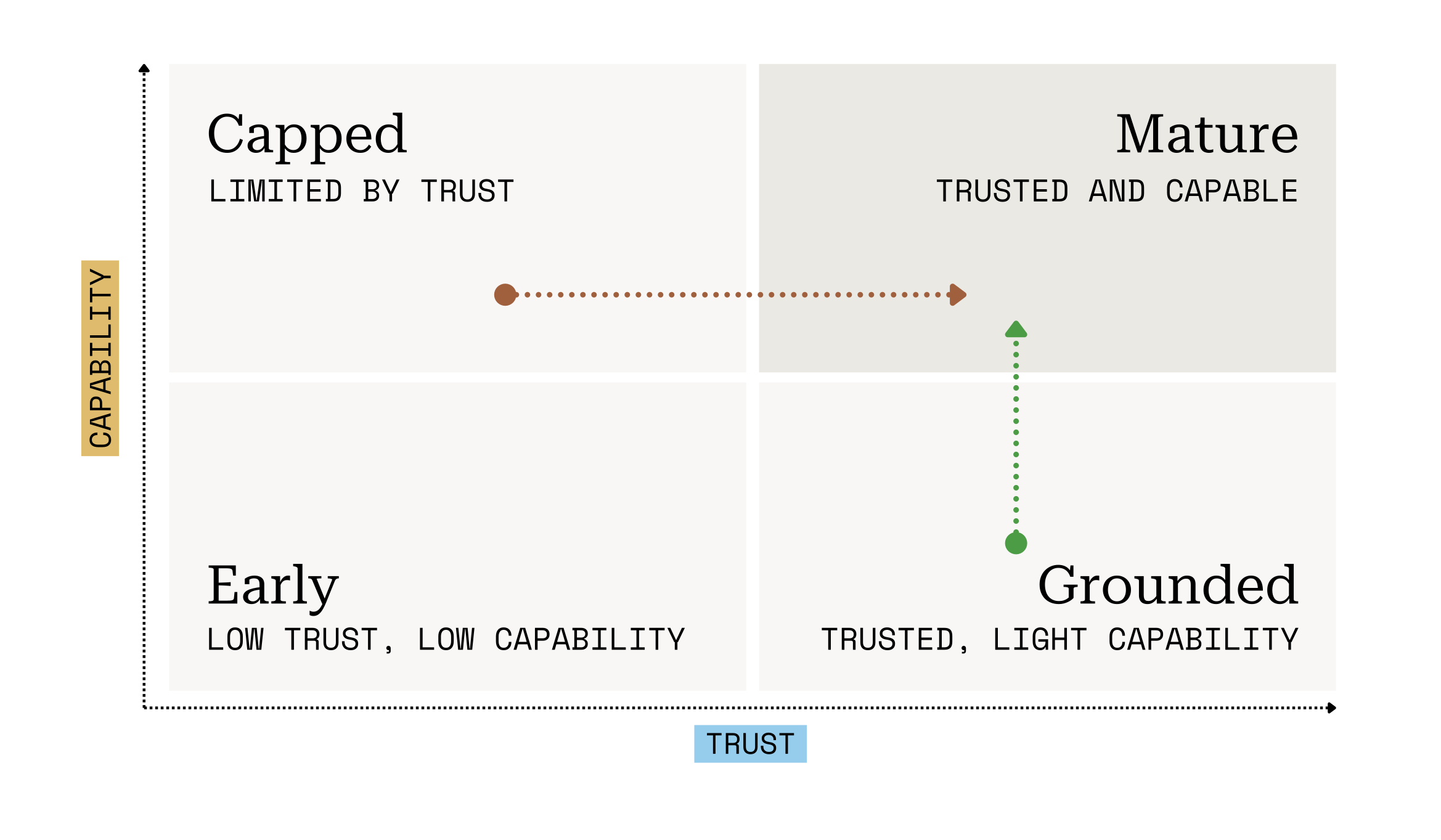
We plot your assistant by trust and capability, showing exactly where you are now. A capable assistant that customers go round is held back by broken trust, so the way forward runs through trust first. Then we help you do the work to get where you want to be.
Conversational Capital in detail: what builds it, what burns it, why your current metrics miss it, and what the assessment measures. Submit the form and we’ll email you the Conversational Capital brochure.
Must read for: Heads of CX and Digital, Conversational AI leads, finance partners, anyone who has to show what the AI is worth






CDI is preparing the first Conversational Capital Index: a periodic, industry-by-industry view of how the major conversational AI deployments are performing.

Hans's book on Conversational Capital will be published in 2026. It is the authoritative guide to Conversational Capital and how it drives business value.
The trust and goodwill your customer interactions build over time; every conversation is a deposit or a withdrawal. When everyone has the same AI, trust is the differentiator. CDI's Conversational Capital Baseline Assessment discovers how you are building Conversational Capital.
Conversational Capital in reverse: the trust you burn when AI is clumsy, curt, or wrong at scale. It hides in the dashboards. A CDI assessment finds where it's accruing before customers leave.
Understand the customer, and get things done for them. CDI builds your skills through our Agentic Experience Design workshops and courses in our Academy.
Containment and CSAT miss it. CDI scores it with the Conversational Capital Rating: one rating out of 100 for whether your AI is building trust or spending it, built from six measures read from your real conversations and your contact-centre counts.
Three things you already have: a few hundred of your assistant's conversations per channel, monthly counts by topic from your contact centre, and the cost of one contact with a person; and, if you have them, your churn rate and revenue per customer. There is no integration to build and no new tracking to switch on.
From one figure you already know: what a contact with a person costs. The CCR counts the work the assistant finished that customers did not repeat to a person, and the work they took to a person anyway, and prices both. Where customers can leave, your churn rate and revenue per customer put a floor under the customers at risk, usually the largest of the three figures.
A structured diagnostic of whether your AI conversations build or burn trust. You get a Conversational Capital Rating and a prioritised set of fixes. Read about the assessment.
Start with a Conversational Capital Baseline Assessment: we read a sample of your conversations and your contact-centre counts, and return your Conversational Capital Rating, what your assistant is worth in financial terms, and the fixes worth doing first.
No; that's usually the right time. An assessment shows whether what you've already shipped is building trust or quietly burning it, and where the Emotional Debt is accruing before it shows up in your numbers.
Yes. The assessment is the starting point. Our consulting engagements, or a Forward-Deployed Expert working inside your team, lift what's weakest, and a re-assessment shows how your score has moved.
Tell us what you're building. We'll respond with where we think Conversational Capital is being created, where it's being burned, and what we'd do next.