

)


)


Hybrid systems over hype
Now that we are completely immersed in the era of Large Language Models and Agentic AI, our industry needs to redefine what 'good' actually looks like. It’s no longer just about checking a box to see if a bot successfully used an API, matched the golden' answer, or retrieved the correct data. It’s about comprehensive, continuous testing to ensure these systems respect human social dynamics. Because even in this new era, conversational quality and trust are non-negotiable.
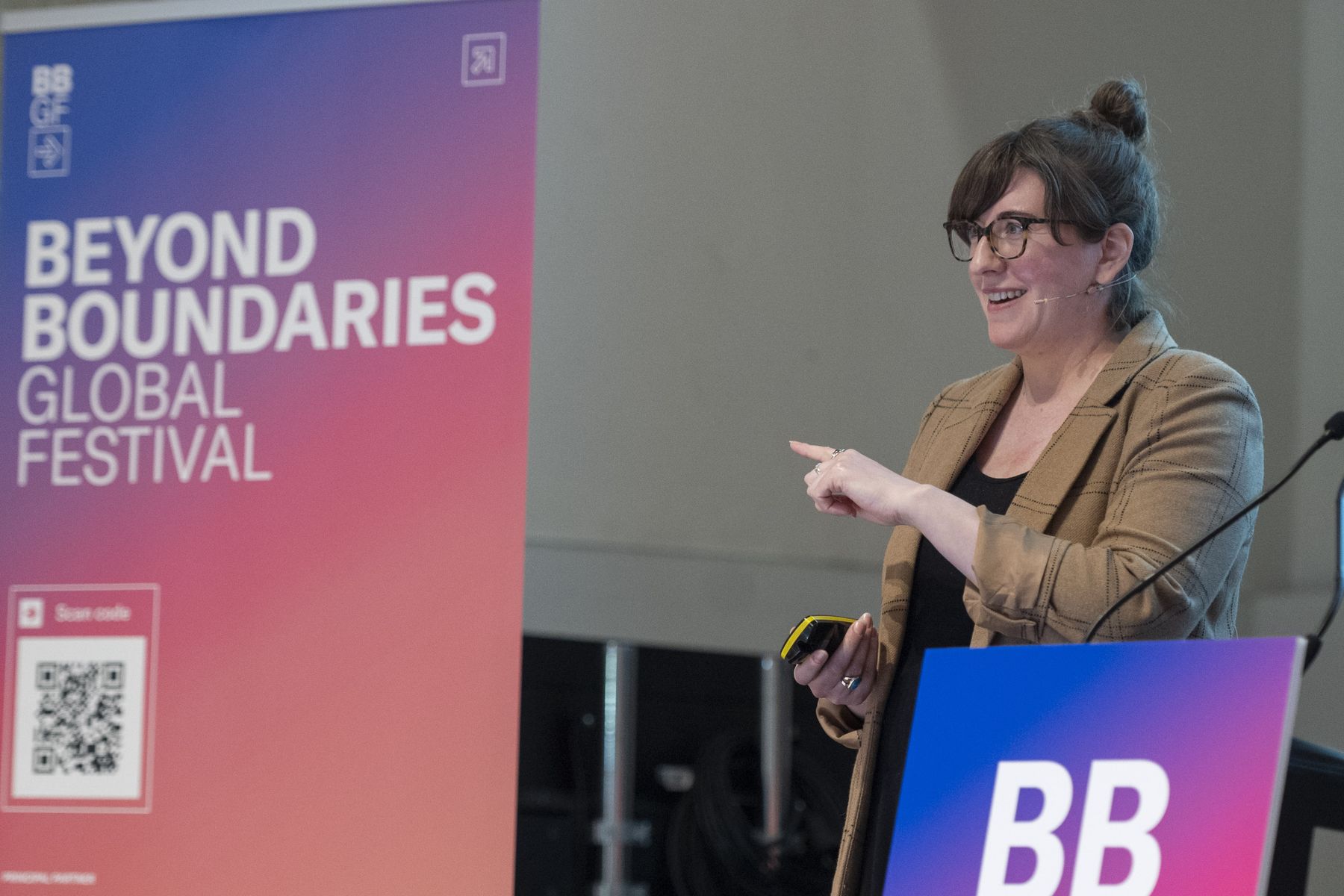
It was exactly this human-first mindset that echoed through the beautiful, historic arcades of the Museu Marítim during the Beyond Boundaries Festival in Barcelona (April 28–30). Inspired by those sessions, I’ve written a series of blog posts capturing the keynotes that best define this new era of AI.
Rebecca Evanhoe
Conversation Design strategist and author of Conversations with Things, Rebecca Evanhoe, shared a great case study on how her team has been intentionally "LLMifying" their voice agents, which handle complex restaurant reservations over the phone.
Right now, the trend is to jump completely on the LLM train and go all-in. Despite spending years perfecting their existing conversational stacks, many companies want to replace everything with an LLM overnight. Rebecca brought us back to reality and shared why we should not do this.
Her strategy? Instead of a risky, platform-wide swap, her team approached LLMs through a series of narrow and very specific experiments. They built a hybrid system, combining the safety of deterministic paths with the power of LLMs only where they truly add value. This pragmatic approach is the exact strategy needed to protect your corporate Trust Ledger.
Here are my top takeaways from her session:
1. To LLM or not to LLM
Rebecca emphasized that we must understand which topics are just too risky or difficult to handle purely with a non-deterministic LLM. For instance, collecting a customer's exact reservation name or date requires strict accuracy. If an LLM hallucinates or misspells a name, the reservation is ruined.
By keeping high-risk, complex flows deterministic and using LLMs only for smaller rephrasing tasks or FAQs, you prevent catastrophic trust withdrawals and can start automating safely.
2. Timing and silence
Two of Rebecca’s observations really stuck with me: timing is a signal, not noise, and sometimes, doing less makes an agent feel more human. In voice design, a brief pause or silence is often treated as an error or a metric to be reduced. But designers know that silence carries social meaning when timing it correctly.
By designing single-line turns, small acknowledgments, and minimal sounds, we prevent content debt and generate steady deposits into the Trust Ledger. Just because the machine mimics natural human pacing.
Rebecca’s session taught us the power of being intentional. By treating LLM integration as a series of controlled experiments and prioritizing natural human pacing over raw speed, we protect our brand's Conversational Capital while pushing the boundaries of what's possible with automation.
