

)


)


Why your AI agent can spend your trust
Now that we are completely immersed in the era of Large Language Models and Agentic AI, our industry needs to redefine what 'good' actually looks like. It’s no longer just about checking a box to see if a bot successfully used an API, matched the golden' answer, or retrieved the correct data. It’s about comprehensive, continuous testing to ensure these systems respect human social dynamics. Because even in this new era, conversational quality and trust are non-negotiable.
It was exactly this human-first mindset that echoed through the beautiful, historic arcades of the Museu Marítim during the Beyond Boundaries Festival in Barcelona (April 28–30). Inspired by those sessions, I’ve written a series of blog posts capturing the keynotes that best define this new era of AI.
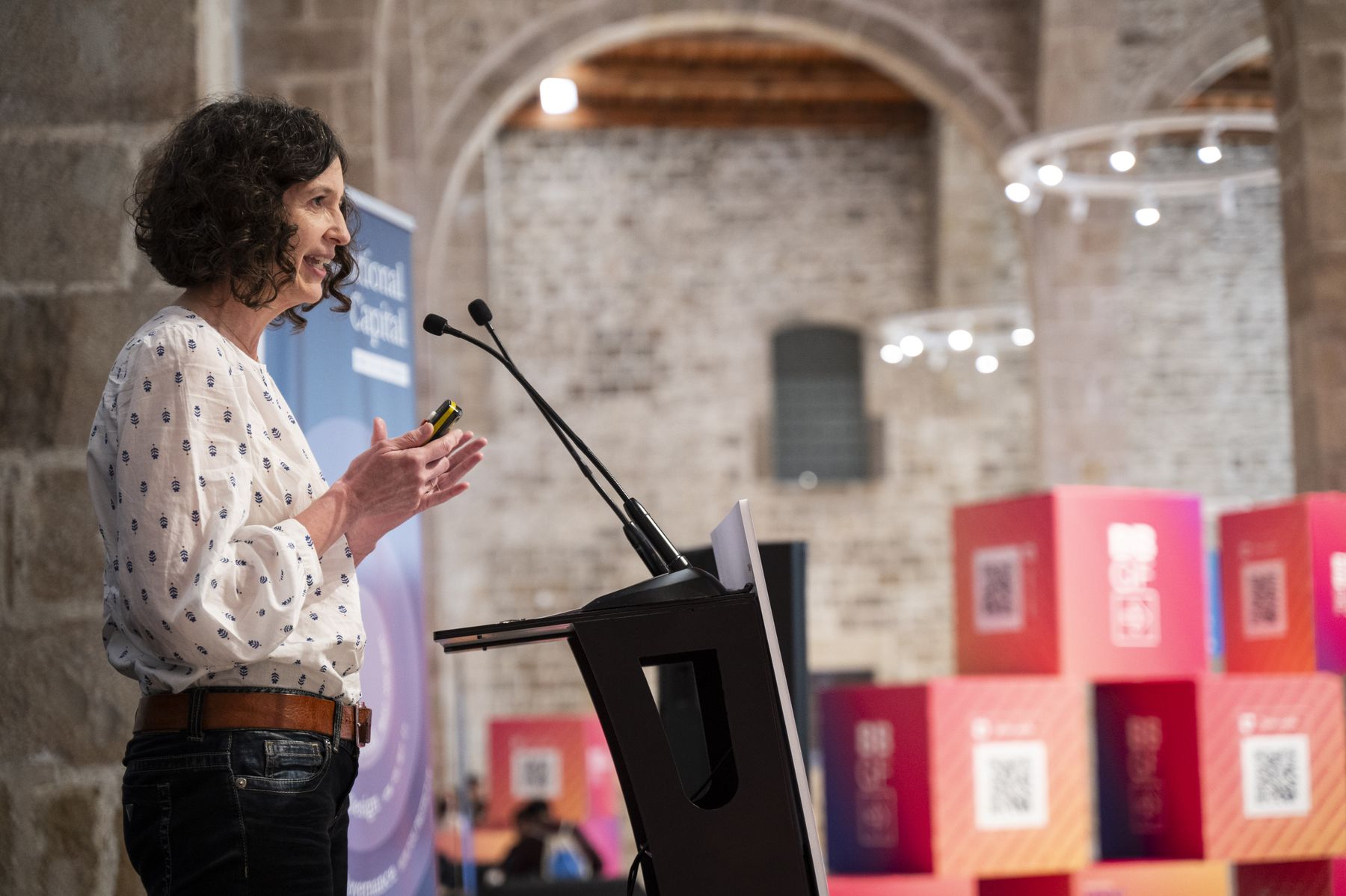
Elizabeth Stokoe
As a Client Strategist at Conversation Design Institute, I love the tech. But my actual job is to look past the hype and focus on the humans using it: the customers. Right now many organizations are running into a big problem. They are measuring speed and efficiency, which results in becoming more blind to the invisible cost of automated conversations.
At CDI, we look at this through the lens of Conversational Capital: the idea that every single turn in a conversation is an entry on a corporate Trust Ledger. Every smooth interaction adds a deposit, every friction point or unhappy moment forces a withdrawal.
Listening to Professor Elizabeth Stokoe’s keynote, everything connected for me. Her talk went back to the very origins of what 'conversation' and 'conversational' actually mean. No matter how advanced or inventive AI technology becomes, if we want it to communicate with humans and feel trustworthy, we must always return to these core foundations. Just like the beautiful Gothic arcades that serve as the backbone of the venue itself.
Two other takeaways from Professor Elizabeth Stokoe’s talk also stood out to me:
1. Simulating a soul
When brands worry that their AI feels too robotic, the immediate reaction is usually to try and program soul into it. We prompt LLMs to say things like, I completely understand how frustrating that must be, and as an AI assistant, I am here to help.
But as Professor Elizabeth Stokoe mentioned in her talk: AI agents cannot engage in true, reciprocal connection because they don’t have a ‘self’ to share.
As humans, we know instinctively when empathy is being faked. In the Conversational Capital framework, we believe that faked empathy drains user trust much faster than a technical error. Customers don't need our AI to pretend to care. They just need it to be transparent about what it is, how it can help and deliver as it promised to do.
2. Tiny words but massive ledger movements
Stokoe’s research also highlights that human interaction is a highly sophisticated system. The tiniest change in wording determines how a human reacts. For example, shifting a question from Are you interested? Would you be willing? changes the social friction and flips the conversation around.
When LLMs generate text on the fly, companies quietly build up content debt. The agent might get the data 100% right, but if its phrasing breaks social norms, the customer gets irritated and trust is withdrawn.
Now that we are moving from bots that just provide information to autonomous agents that act, the stakes are higher than ever. An informational mistake is annoying, but an automated action failure caused by clumsy conversation design can really damage a brand's reputation.
Bigger is not always better
Now that we are pushing the boundaries of Agentic Experience Design, we have to realize that just throwing a bigger, more powerful LLM at the problem won't fix this.
We need Conversation Designers who understand the micro-nuances of human talk and behaviour to build systems that aren't just functional, but what Professor Elizabeth Stokoe calls ‘conversationable’. The Trust Ledger is always running in the background. Every word choice matters, and every turn counts.
