

)


)


Why your AI agent might be culturally clueless
Now that we are completely immersed in the era of Large Language Models and Agentic AI, our industry needs to redefine what 'good' actually looks like. It’s no longer just about checking a box to see if a bot successfully used an API, matched the golden' answer, or retrieved the correct data. It’s about comprehensive, continuous testing to ensure these systems respect human social dynamics. Because even in this new era, conversational quality and trust are non-negotiable.
It was exactly this human-first mindset that echoed through the beautiful, historic arcades of the Museu Marítim during the Beyond Boundaries Festival in Barcelona (April 28–30). Inspired by those sessions, I’ve written a series of blog posts capturing the keynotes that best define this new era of AI.
Elizabeth Rodwell
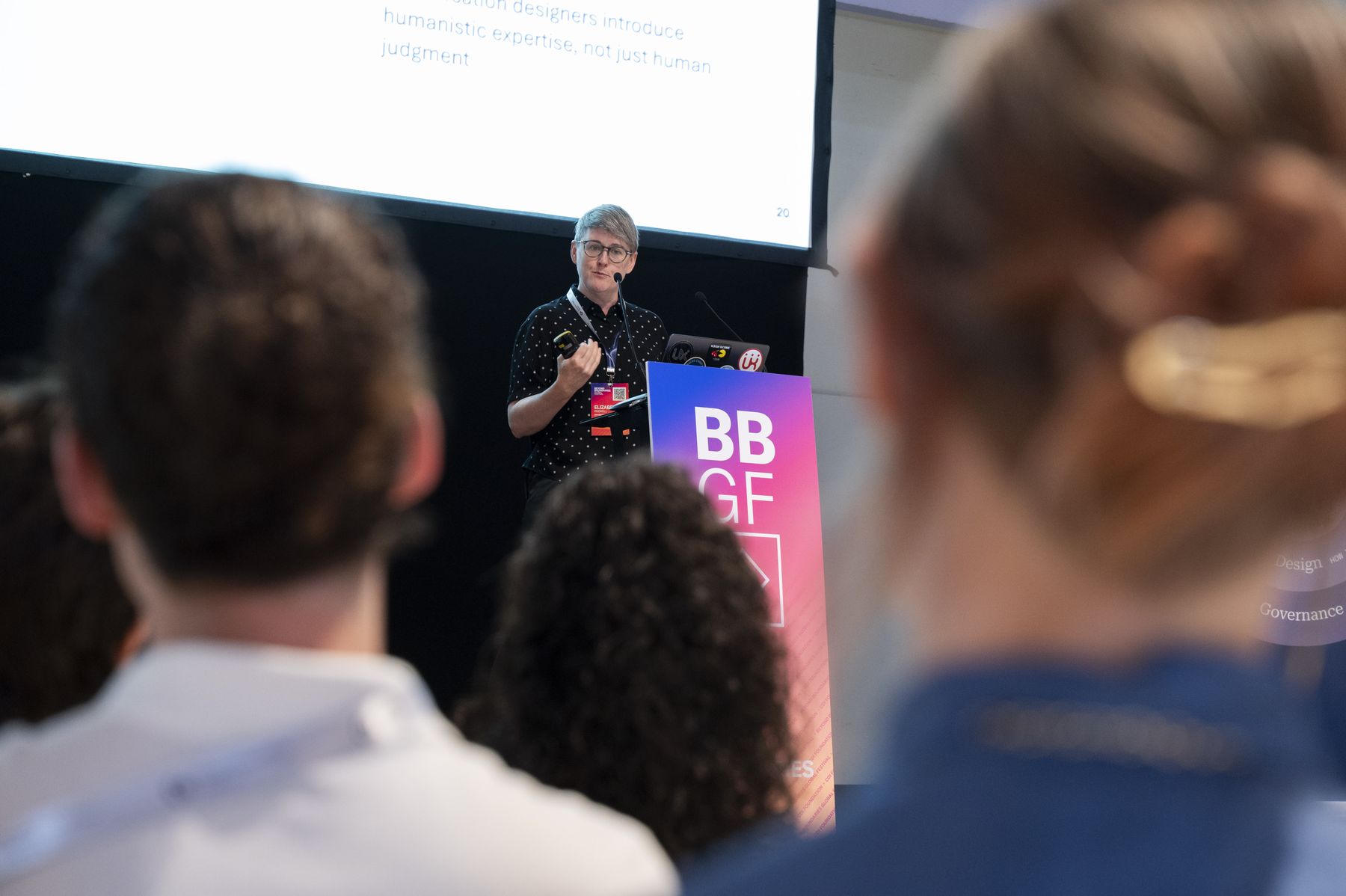
On the second day, Elizabeth Rodwell, Associate Professor of Digital Media Technology, took us on a social scientist journey. In her session, she brought a fresh perspective to the table. While tech teams are hyper-focused on code, data pipelines, and prompt engineering, she reminded us that conversations don’t happen in a vacuum. They happen within culture, history, and hardwired behavior patterns.
And exactly that is something that the standard models are not able to process in their output (yet). Lately, I've been reading more and more articles highlighting a challenge: English has become the default language of AI. Most large language models are trained on Western-centric data, which means their underlying logic, politeness standards, and conversational structures are inherently English.
If you’re working in the conversational space, you know that we never design for a universal user. Even within one organization, there are often multiple personas developed to make sure our designs are inclusive. But what if you just use these ‘default’ LLMs in your workflow, expecting them to behave correctly? Then you’re seriously at risk of harming your Conversational Capital.
To solve this, we should start using Elizabeth's advice:
1. Watch the real world
When we design for AI, we should dive into the culture we are designing for. How? Elizabeth emphasized the power of ethnography: the practice of deeply observing people in their natural environments to understand how they actually live and talk, rather than just asking them in a survey.
When we design agentic workflows based purely on what we think customers do, we are definitely building broken paths. Every time an AI forces a user into this artificially designed path that doesn't match their real-world expectation, it’s a direct withdrawal from the Trust Ledger. Social science teaches us to watch human behavior first, and then build the tech to mirror that reality.
2. Integrate social science
As LLMs become more autonomous, they are entering sensitive human spaces like mental health, finance, and career planning. Elizabeth highlighted that social scientists are trained to look at the ethical, systemic impacts of technology. So integrating social science into your design processes or even better, inviting social scientists, anthropologists, and ethnographers to the design table, means you can create ethical guardrails before a single line of code or prompt is written. A massive capital deposit according to the Trust Ledger framework.
To me, Elizabeth’s keynote was a powerful reminder that the ‘AI revolution’ isn't just an engineering challenge. It's a human one as well. Because we need to build systems that aren't just functional, but intelligent and socially aware too. And who can teach them to do that better than we, humans ourselves?
